Winter
5 Centimeters per SecondWinter is the season in which waiting, distance, and recollection acquire their most tangible form. It first obstructs Takaki Tohno’s journey to meet Akari Shinohara, surrounding their reunion with rain, delay, and snow; much later, falling snow returns him to that night and to the cherry tree they saw together. Across these scenes, winter does not simply mark when events happen. Its changing weather gives emotional experience a landscape, while its recurring snowfall links an intense youthful memory to the quieter pain of adulthood.
Weather, Waiting, and Reversal
The promised meeting begins under rain rather than snow. Rain falls from morning beneath a solid gray sky, and the day seems to reverse the approach of spring: the weather has turned back, and the air carries the feeling of deep winter. Takaki puts on a dark-brown duffle coat over his school uniform and places his letter to Akari at the bottom of his schoolbag. He expects to return around midnight, leaves a note for his parents, and spends his classes looking out the window. The rain becomes part of his effort to contain his anticipation: imagining Akari’s voice warms him, and he looks outside to cool himself.
The journey makes winter’s power over time literal. Snow delays the train for more than two hours, and Takaki reaches Iwafune Station after eleven at night, more than four hours after the agreed meeting time. Fresh snow covers the platform and sinks beneath his shoes; beyond its unprotected edge, a snowfield stretches into the distance, while the town’s few lights remain far away. With the train idling behind him, the sparse sounds and lights make the delay feel like an isolation as well as a practical setback. Winter has separated the pair not by a great geographical distance but by the slow passage of hours.
Snow at Iwafune
The station interior briefly offers warmth against that exposed landscape. After crossing a small pedestrian bridge and passing the ticket gate, Takaki enters the wooden station building and encounters the warm air and nostalgic smell of a kerosene stove. Akari is sitting nearby, her head drooped. When he calls her name, she raises her head slowly. The scene’s movement from the snowbound platform to the stove-lit waiting room gives the meeting a threshold: the long, cold approach ends in recognition, but only after the time they had planned to share has already been lost.
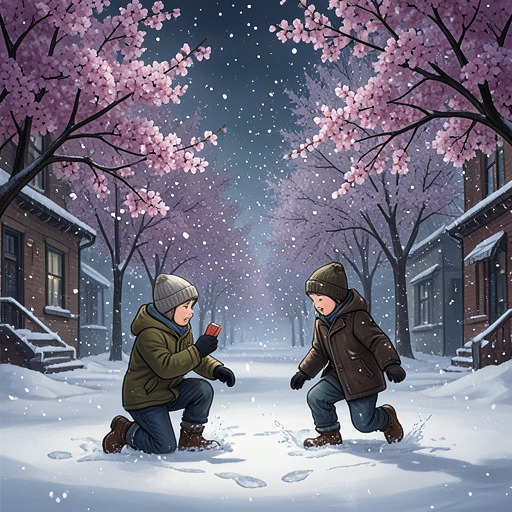
Outside, the snowfall continues, yet the late-night world no longer feels cold to the pair as they walk side by side. Streetlamps illuminate patches of snow like spotlights; Akari runs toward them, and Takaki notices that he is now several centimeters taller than her. Their walk leads about ten minutes from the station, away from houses and artificial light, to a tract of farmland. There the snow gives the landscape a faint illumination, and a tall, thick cherry tree stands alone beside a path between rice paddies. Snow drifts through its interlaced branches. Akari’s remark, “Look, it’s almost like snow,” joins the falling flakes to the tree’s anticipated blossom, holding the season’s stillness beside the promise of spring.
The tree and its setting make the meeting difficult to reduce to a simple reunion. The snow-covered fields are beautiful and quiet, but they also surround the pair with darkness and separation from the town. The cherry tree is a place Akari had written about before; finding it gives their meeting a shared point of attention beyond the lateness of Takaki’s arrival. Winter thus contains both the strain of missed time and a brief intimacy created by walking together through the snow.
Snow as Recalled Time
Much later, a winter night in the city revives the memory of that tree. Takaki is in his apartment, unable to sleep, reading a book from the stack on his floor and drinking beer. Snow has fallen since noon, at times changing into rain before returning to snow; after sunset, the flakes grow larger. A late-night foreign film plays on the television at low volume, while the half-open curtain leaves the city lights and snowfall in view. When he turns off the television because he cannot concentrate, the silence becomes more pronounced: the last trains have run, and he can hear neither traffic nor wind. It is in this quiet that a feeling of nostalgia and warm protection returns, leading his thoughts to the cherry tree he saw that winter long ago.
The recollection is prompted not by an explanation or a deliberate search through the past, but by a familiar season and an altered city soundscape. The snowfall links the present apartment to the earlier walk without making the two moments equivalent. The first snow belongs to a shared night with Akari; the later one reaches Takaki alone, through memory. Winter’s recurrence therefore preserves the emotional force of the past while making its distance newly visible.
The Adult Present and Winter’s Return
In another urban snowfall, Takaki cannot bring himself to answer a call from Risa Mizuno. He watches her name on the phone’s small display as it vibrates and falls silent, and feels pain without being able to identify what hurts. His attention shifts from the black wall of the building and its lit windows to the red aircraft warning lamps and the starless sky. Small fragments drift down, and he recognizes them as snow. The recognition gives the weather an immediate, concrete presence at a moment when he cannot make sense of his feelings.
Set beside the remembered walk, this scene changes winter’s emotional register. At Iwafune, falling snow accompanies Takaki and Akari together beneath the cherry tree; in the city, it descends while Takaki remains alone with an unanswered call and an indistinct hurt. The snow does not explain that hurt or resolve his relationship with Risa. Instead, its return connects different moments through sensation, allowing the old image of winter to persist even as the circumstances around Takaki have changed. The season’s significance lies in this contrast: it can make a youthful memory feel warmly present, yet it also marks how little that presence can do to alter the adult present.